Meet Herman, the AI credit analyst for mortgage lending
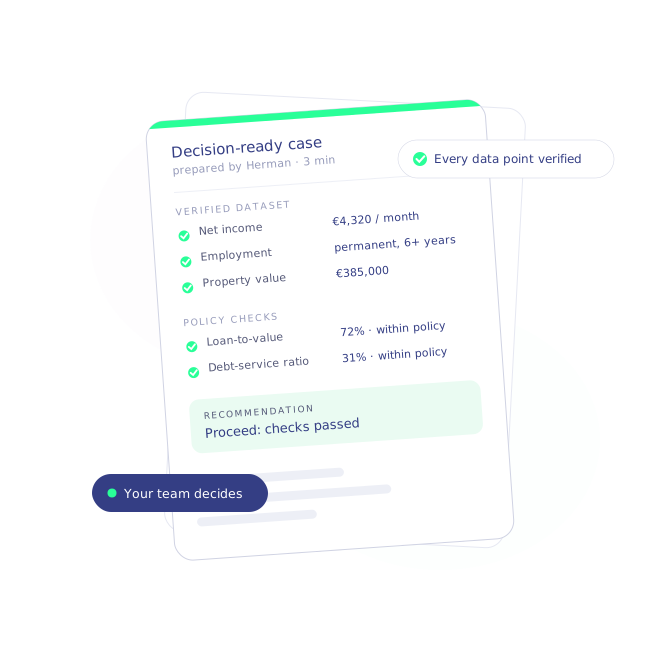
Herman reads the documents, verifies every data point, applies your credit policy and hands your analyst a decision-ready case in minutes.
How Herman works
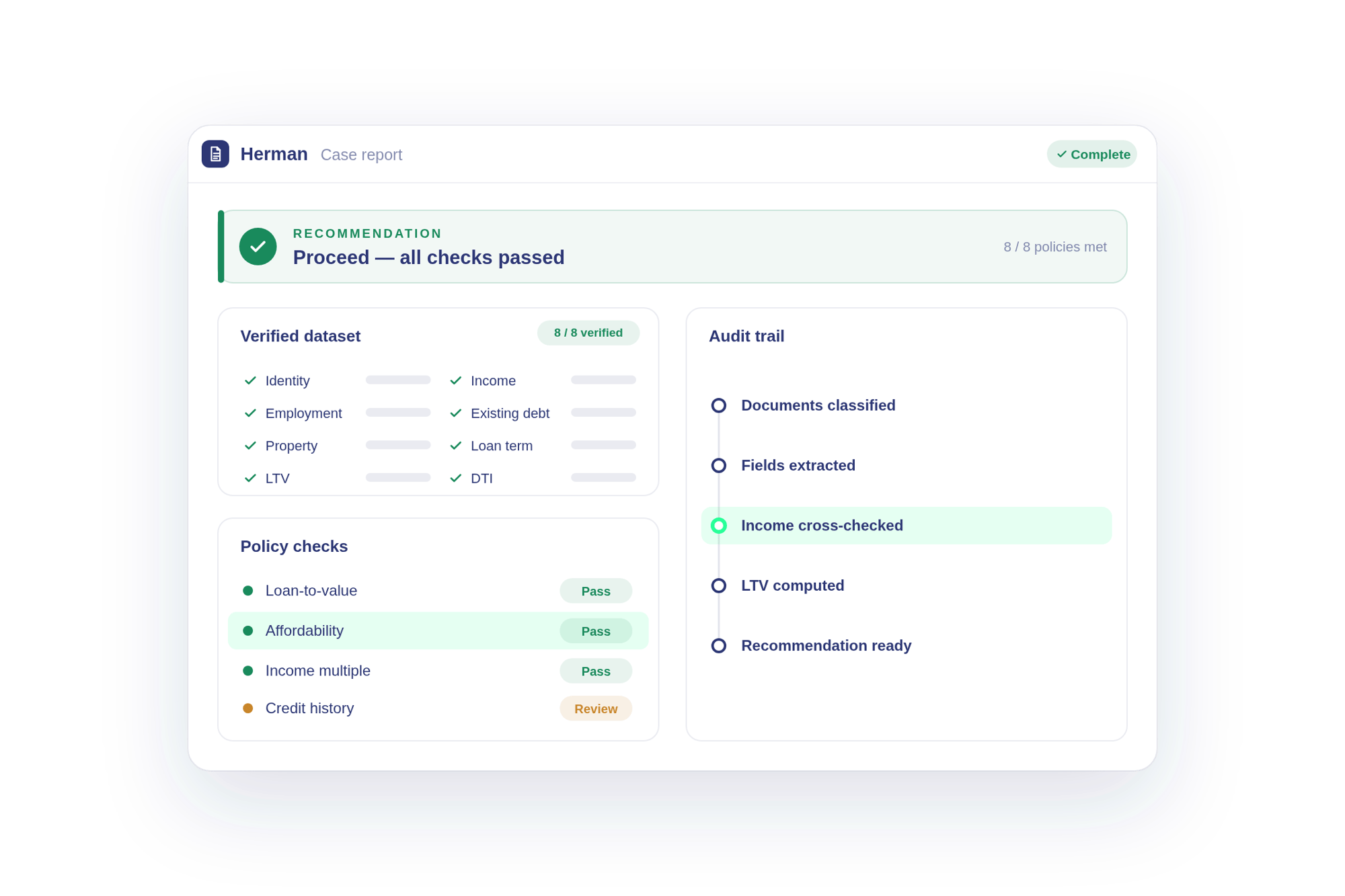
Every step is logged, and every conclusion links to its evidence.
1. Collect & Classify
Intake from the portal, email or API. Every document in the file is split, labeled and filed.
2. Extract & Verify
Fields are extracted and validated, and the application is cross-checked against the supporting documents. Missing pieces are flagged at intake and go straight back to the broker.
3. Apply your credit policy
Your credit policy, applied the same way to every file. Full or simplified check sets, depending on the use case.
4. Decision-ready output
A structured case report with a recommendation. Every conclusion links to its evidence and its policy reference.
What lands on your analyst’s desk
A complete and verified dataset, policy results with reasoning, a structured recommendation and the audit trail behind every step.
Modernize without replacing
Herman works on top of your loan origination system and document management, so there is no core migration. It connects through REST API and event streams, email and Microsoft Teams, or your existing screens.
Herman runs in European cloud regions, Frankfurt and Switzerland by default, or in your own environment.
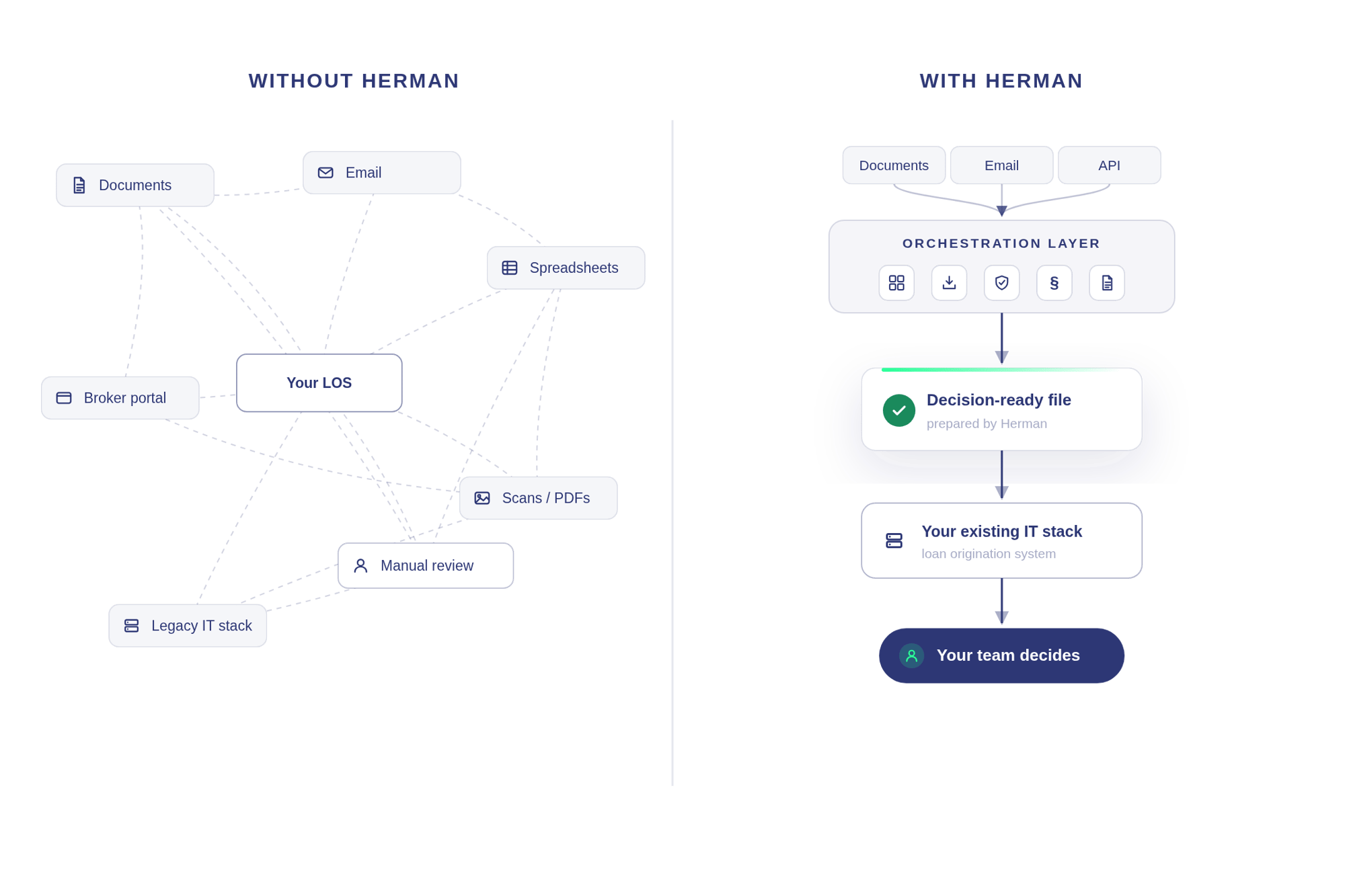
A plug-in solution, ready to use: all the ingredients to build the AI credit analyst that fits your systems, whatever your IT setup. In production within months, not years. New use cases follow within weeks.
API
API
REST and event streams: the cleanest integration and the cleanest audit trail.
Email and Microsoft Teams
Email and Microsoft Teams
Herman reads the inbox or chat, processes the case and returns structured output.
Computer Use
Computer Use
No API? Herman operates your existing systems the way a person would.
What changes with Herman
Results from Herman in production at European lenders.
average case preparation time, down from 120 minutes.
data extraction accuracy across document types.
of underwriting tasks handled without manual intervention.
| Without Herman | With Herman | |
|---|---|---|
| Completeness | Gaps found mid-analysis | Flagged at intake |
| Policy application | Varies by analyst | The same on every file |
| Audit trail | Reconstructed afterwards | Written as Herman works |
“By integrating AI into our document analysis process, we free up valuable time for our experts to focus on each applicant’s specific situation. Herman supports our team in handling administrative complexity, so we can invest more attention in responsible lending and in connecting borrowers to renovation advice through our One-Stop Shop model.”
Hans Vermeulen, CEO, Onesto
Built for bank scrutiny
You define the rules and own the audit trail. The questions your risk team will ask, answered:
In one storage boundary: the Briefcase, inside your tenancy. Documents, extracted data and outputs live in a single isolated store, never used for training. You define retention; a temporary mode deletes everything after each run.
No. Herman prepares a decision-ready case with every conclusion linked to its evidence and policy reference. Herman does not approve or reject loans.
It depends on what Herman does for you. Document checks, such as completeness, consistency and rule checks, are preparatory tasks and are not high-risk under the EU AI Act. When Herman supports the credit assessment itself, we treat it as a high-risk use case and build it for those rules: human oversight, logging and explainable outputs. We share our assessment with your risk team.
Every recommendation is explainable and linked to its evidence and the policy rule behind it. Every step is logged.
No. Herman does not do credit scoring. It applies your written credit policy the same way to every file, not an opaque score on borrower characteristics.
ISO 27001 certified, DORA-ready, GDPR by design, with the contractual framework regulated lenders need: audit rights, an exit plan and incident reporting.
In European cloud regions, Frankfurt and Switzerland by default, or scoped for deployment in your own environment.
How you start
Three phases, each with a clear result before you commit to the next. Oper builds and maintains Herman, so your team does not have to build the AI itself.
Phase 1
See it on your cases
You send us historical cases; we backtest Herman on your document types and show you the results.
Phase 2
Your analysts start working with Herman
A limited set of live cases in your environment; integration and data-protection questions are answered in practice.
Phase 3
Full rollout
Herman processes every new file, live inside your existing systems.